THE RECENT HISTORY OF NDT
NDT – also known as Non-Destructive Testing – is the general term for inspection methods used to detect defects and discontinuities on the surface and inside a material or component without damaging its integrity or internal structure. In this article, we will take a look at the recent history of NDT.
With the Second World War, the importance of near-perfect production became evident. The increasing production during this period created a need for more testing equipment and testing methods. As a result, many techniques and methods were developed. The exact origin of the first industrial NDT application cannot be clearly defined, but radiographic inspection is widely accepted as the first method.
Radiographic Testing (RT)
In 1895, Wilhelm Conrad Röntgen discovered X-rays, which are also named after him, and was awarded the Nobel Prize in Physics for his work. At that time, medicine rather than industry needed such a method. Industrial use of X-rays had to wait until the 1930s. During these years, Richard Seifert developed early X-ray inspection techniques by modifying medical equipment and used them successfully. He also collaborated with welding institutes. His groundbreaking work led to competitors such as Siemens and C.H.F. Müller. Seifert’s company still exists today under a global organization.
Radiographic testing is performed not only with X-rays but also with gamma radiation emitted by radioactive isotopes. Early studies on radioactivity were conducted by Marie Curie using uranium, and she was awarded the Nobel Prize in Physics together with Pierre Curie and Henri Becquerel. As with X-rays, these isotopes were first used in medical applications. In parallel with Seifert’s work, Rudolf Berthold and Otto Vaupel applied gamma rays to welded components.
After the Second World War, Arturo Gilardoni in Italy, Drenk and Andreasen in Denmark developed X-ray equipment, while Kurt Sauerwein in Germany developed portable isotope containers. Today, many companies produce X-ray generators and radioactive isotopes (commonly Iridium, Selenium, and Cobalt).
Magnetic Particle Testing (MPI-MT)
Magnetic Particle Testing was actually used much earlier than radiographic inspection. In 1868, S.M. Saxby and in 1917 William Hoke succeeded in detecting cracks in gun barrels using magnetic indicators. However, true Magnetic Particle Testing was developed by Victor de Forest and Foster Doane in the late 1920s. The company they founded is still one of the most well-known manufacturers of magnetic particle and penetrant testing products.
In Europe, the Italian Giraudi first applied magnetic particle testing with a device called “Metalloscopio.” In Germany, Berthold and Vaupel also applied the method to welded parts. After World War II, Wilhelm Tiede, a former Seifert employee, founded his own company in Southern Germany to produce magnetic particle consumables. By the late 1950s, manufacturers of dry magnetic powders entered the market, and today dozens of companies produce magnetic particle testing products.
Penetrant Testing
In the second half of the 19th century, a method known as “oil and chalk whitening” was used for railway components. In this method, components were immersed in oil, excess oil was drained, and then chalk or lime was applied to the surface, forming a primitive form of penetrant testing.
With the Second World War and the rapid growth of the aviation industry, there was a shift toward lightweight non-magnetic metals. As a result, several independent manufacturers in the USA and Europe began producing fluorescent and red dye penetrants.
Ultrasonic Testing
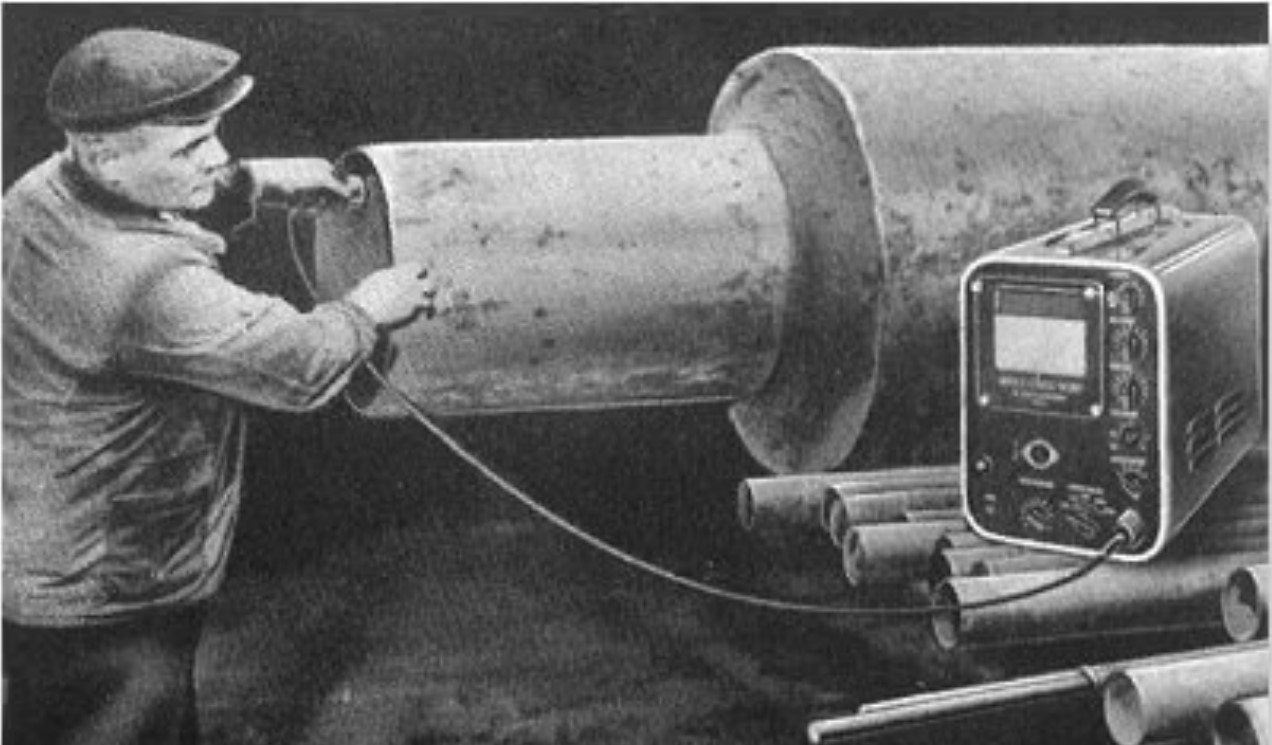
Ultrasonic testing was adopted relatively later compared to other techniques. Historically, Chilowski and Langevin first worked on ultrasonic sound waves during World War I to detect submarines. In 1929, Sokolov proposed using ultrasound for testing cast parts. During World War II, the detection of laminations and inclusions in plates became essential, and existing methods such as PT, MT, and RT were insufficient. At the same time in the USA, UK, and Germany, Floyd Firestone, Donald O. Sproule, and Adolf Trost independently worked on ultrasonic inspection techniques. By the 1950s, Karl Deutsch and Josef Krautkrämer independently developed ultrasonic testing devices, and their competition continues to this day.
Today, hundreds of companies operate in the NDT field. They continue to work under strong competition to improve the quality of industrially produced parts for the benefit of customers.